Why Does Eating Beef Contribute to the Greenhouse Effect Yahoo Answer
10% of Canada'due south greenhouse gas emissions are from crop and livestock production, excluding emissions from the use of fossil fuels or from fertilizer product.
The main gases emitted by agricultural activities are:
Conversely, agriculture helps slow climate change by storing carbon on agronomical lands. Storing, or sequestering, carbon in soil as organic matter, perennial vegetation, and in copse reduces carbon dioxide amounts in the temper.
For more information on how to estimate farming greenhouse gas emissions and examination ways to reduce these emissions, please visit: Holos software program.
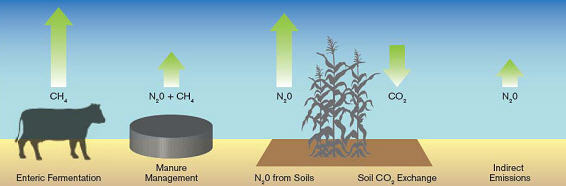
Note: The size of the arrow indicates the relative magnitude of the emission or corporeality sequestered
Description – Sources of Greenhouse gas emissions from Canadian agriculture excluding COii emissions associated with energy employ.
Figure shows the relative magnitudes of greenhouse gas emissions from four sources. From highest to lowest the emitters are CHiv from enteric fermentation, Due north20 from soils, Due north20 + CH4 from manure, and indirect emissions of Northwardii0. The effigy also shows absorption of CO2 from the temper by soils in approximately the scale of emissions past manure and indirect emission.
Agronomical activities inevitably result in multiple greenhouse gas emissions. Nitrous oxide emissions can originate direct from field-practical organic and inorganic fertilizers, crop residuum decomposition, cultivation of organic soils, and from the storage of manure. Indirect nitrous oxide emissions can originate from nitrogen moved offsite such as from the volatilization and re-deposition of ammonia and from nitrogen leaching and run-off.
Methane emissions from agricultural sources in Canada are mainly a issue of enteric fermentation in ruminant animals and from the anaerobic decomposition of stored manure. When organic matter in feed or manure decomposes under anaerobic conditions, a portion is released as methane.
Agricultural soils can either emit or absorb carbon dioxide. The difference is adamant by the net effect of carbon dioxide absorption from the atmosphere past growing crops, and subsequent storage in the soil in the form of ingather residues and soil organic affair, and emissions to the temper via decomposition of crop rest and soil organic matter.
Agronomics emits all three greenhouse gases: carbon dioxide (CO2), marsh gas (CH4), and nitrous oxide (N20). These gases differ, though, in their ability to trap heat; tonne for tonne, CHiv is more twenty times as effective at trapping heat as CO2, and North20 is virtually 300 times as effective as COtwo.
To compare the emissions of these gases on equal terms, nosotros usually speak of COii equivalents (for example, Due northtwo0 has 298 COii equivalents).
Agriculture also removes COtwo from the atmosphere - croplands and grazing lands can be managed to remove and store large amounts of CO2 every bit soil organic carbon.
Learn more about:
- Measuring emissions
- International efforts
Carbon dioxide
Nature uses carbon to shop free energy. In the air, carbon exists generally as carbon dioxide (CO2). Through photosynthesis, green plants invest the sun's energy in this CO2, building from it first sugars and then other energy-rich forms. Plant materials are then eaten past other organisms-microbes, cows, and humans, among others-who, in result, burn down the material back to COii, using the solar free energy information technology contains to alive and grow.
Some of the energy-rich carbon materials can exist stored for thousands or millions of years before being converted back to COii. For instance, soils contain vast amounts of carbon held in organic thing (humus), and the carbon in fossil fuels such every bit coal, oil and natural gas, which is solar energy trapped by plants eons agone.
Soil carbon
Farms and other ecosystems can be likened to batteries; building carbon stocks is like charging the battery and losing carbon like discharging information technology. On Canadian farms, carbon is stored mostly in the organic thing of soils. Changes in amounts stored depend on the rate of carbon coming in as plant litter, compared to the rate of carbon lost through decay.
If the rate of carbon input exceeds the rate of loss, carbon accumulates. This is called a carbon sink. If the rate of carbon added is less than the rate of the loss, carbon is depleted. This is called a carbon source.
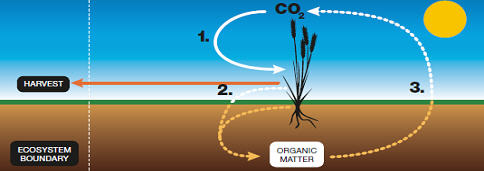
Clarification – The carbon cycle in an agronomical ecosystem
Figure shows a simplified Carbon system. Plants grow utilizing solar free energy and atmospheric carbon dioxide. Constitute tissue is removed from the organisation in the harvest or decomposes to add organic affair to the soil. Biological decomposition completes the cycle by returning COtwo to the atmosphere.
Soil Carbon is dynamic. Changes in the amount of carbon stored in soil organic matter depend on the relative rates of carbon input from plant litter and carbon emitted every bit COii via decomposition. If carbon inputs are greater than carbon loss, then the amount stored increases; if carbon input is less than carbon loss, the amount of carbon stored decreases. To increase stored carbon, practices must either:
- increase plant yield (photosynthesis);
- increase the proportion of fixed carbon added to soil; or
- ho-hum the rate of organic affair decomposition.
What farmers tin can do to enhance the carbon sink
By managing soils for growing crops and raising livestock, the world'due south farmers are unconsciously, managing a soil carbon reservoir that is roughly equivalent to the full carbon that would be released after 100 years of fossil fuel burning at the electric current world rate. In recent years, the size of this immense carbon puddle has changed very little.
Despite the apparent stability of this carbon reservoir, there is zippo permanent well-nigh any of the carbon which it contains, nor of the agricultural practices that promote this apparent stability.
Historically, when lands were start cropped, large amounts of carbon were lost considering tillage accelerated disuse and removal of harvests meant less carbon was returned to soil. But today, farmers can rebuild some of the lost carbon through improved practices.
Past increasing the corporeality of carbon stored in soils, these practices brand soils more productive and resilient for apply by future generations, while standing to remove CO2 from the air.
If country management practices are changed in ways that increase the soil organic carbon, CO2 is effectively removed from the atmosphere and stored or 'sequestered' in the soil. The size of the 'sink' is increased. Farm practices that contribute to the carbon sink are:
- Reduction in tillage
- Restoring degraded land, improving pasture management
- Reducing fallow periods
- Calculation creature manures to the soil
- Ingather rest management
- Using legumes and/or grasses in crop rotations
- Converting marginal ingather state to perennial grass or trees
- Using rotational grazing and loftier-intensity/short elapsing grazing
- Planting shrubs and trees as shelterbelts
- Restoring wetlands
In addition to sequestering carbon in the soil, these practices likewise increase soil productivity, enhance the quality of h2o running off or draining from agricultural state, and provide a more hospitable environs for wildlife inhabiting agronomical lands.
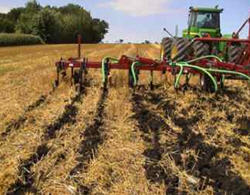
Conservation tillage
These practices tin can as well help improve profitability. For example, minimum tillage increases energy efficiency by reducing machinery use. Improved ingather varieties and ingather fertilization tin increment yields and soil carbon.
In Canada, i-quarter of a million farmers manage most 68 million hectares of state. Overall, these farmers take considerably improved the sustainability of their soil management practices on land used for crops and grazing.
In the year 2000, for the offset time in Canada's history, agricultural soils sequestered more carbon than was emitted. This achievement was the upshot of a potent commitment to address soil degradation, in response to desertification risk and devastating erosion during much of the 20th century.
At current adoption rates of carbon sequestering agricultural practices in Canada, soil carbon accumulation can keep for at to the lowest degree until 2040. Afterward this menstruum, the constancy of sound farming practices that conserve the soil volition maintain this sink rather than increase it.
Marsh gas
Sometimes, when carbon-containing materials decay without sufficient oxygen, microbes produce methane (CH4) instead of carbon dioxide (CO2). On Canadian farms, this can occur in ii situations: CHfour is produced within the rumen (fore-breadbasket) of ruminant animals such as cattle and sheep through a bacterial procedure chosen enteric fermentation and in manure storage sites where high h2o content limits the entry of oxygen.
Enteric fermentation is the biggest source of CH4 from Canadian farms, is important because it enables livestock to convert otherwise boxy materials such every bit grass and hay into usable free energy.
Secondly, CHiv is released from manure storage sites, especially when manure is stored wet or as a slurry, because water prevents the entry of oxygen during decay.
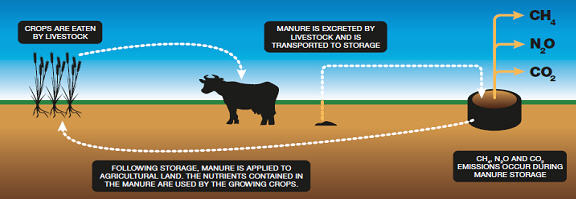
Clarification – Manure is an essential component of mod farming systems
Figure shows a nutrient cycle in a livestock operation and the loss of greenhouse gases from the system. Crops are eaten livestock, manure excreted and moved to a manure storage facility. CH4, N2O, and CO2 emissions are shown as losses to the system. From the storage facility, manure is spread on the land to be taken up by crops, thus completing the cycle.
Nutrients absorbed by crops are fed to livestock, which and so excrete a portion of these nutrients in manure. Although manure represents a disposal liability to the farmers; it too represents a resource, as it contains valuable nutrients which can allow farmers to dispose of manure while providing nutrients to the soil.
Methyl hydride reductions
Scientists accept long studied CH4 emissions from ruminants because such emissions hateful the creature has not efficiently utilized the free energy content of the feed to produce meat or milk. Through research, scientists have found constructive ways of reducing these emissions. One way is to alter the diets of livestock: using high grain rations, calculation fats or oils to rations, and using anti-microbial agents called ionophores, which reduce emissions at least for a time.
Feeding cattle higher quality forage-replacing grass hay with alfalfa, for example-can also reduce emissions of CH4 per unit of beast product. Scientists are besides experimenting with compounds such equally tannins, naturally present in some forages, equally a style of suppressing CH4. Various other agents, including yeasts, organic acids, halogenated compounds such as chloroform, and possible vaccines are also being investigated, although in some cases their effectiveness in reducing emissions has not been widely confirmed.
Beyond these direct methods, CH4 emissions tin be reduced indirectly by choosing management practices that heighten productivity:
- extending lactation periods of dairy cows
- using more efficient breeds
- improving reproductive performance
- increasing rates of proceeds in beef animals and so they reach the market sooner
While these practices may non reduce emissions per animal per solar day, they can lower the amount of CH4 emitted per kilogram of milk or meat produced. Research has also shown that CHiv from manures can be reduced. Direction practices that can be effective include: aerating manure, storing manure at low temperatures (below ground), removing manure from storage more oftentimes and using bedding cloth to improve aeration and composting manure (although the overall effectiveness of this practice may vary, in function because of possible emissions of NiiO).
Some other mode to reduce emissions from manures is to remove CH4 using biological filters or, even better, to trap the CH4 and fire it equally fuel, thereby offsetting fossil fuel otherwise needed.
Nitrous oxide
Nitrous oxide is another greenhouse gas (GHG) emitted from Canadian farms, accounting for about half the warming effect of agronomical emissions. This gas, familiar to united states as laughing gas, is produced in nature past microbes as they procedure nitrogen in soils. All soils emit some nitrous oxide (N2O), simply farm soils often emit more than than others because of the nitrogen that is added to soil in the class of fertilizers, manures and other inputs.
Without these additional inputs to replace the nitrogen removed from farms in harvested grain, milk, meat, and other products, crop yields would before long decline. Simply as the amounts of added nitrogen increase so practice potential losses into the environment, including losses of nitrogen to the air as North2O.
Typically, scientists assume that about 1% of the nitrogen added to farm fields is emitted as N2O, though this can vary widely with soil water content which is influenced by the hilliness of the land and soil clay content (for example, wetter soils tend to have higher emissions).
Aside from the N2O released directly from soils, farms tin too produce indirect emissions. This is where N2O is produced outside the subcontract boundaries from nitrogen leached from fields or emitted into the air as ammonia gas.
This nitrogen, once lost from the subcontract, can find its way into adjacent environments where information technology can be converted and emitted equally NorthwardtwoO. Although not produced on farms, this Northward2O is from nitrogen used on the subcontract; hence, information technology must be counted as farm-derived NorthwardiiO. An illustration of how nitrogen is cycled in a subcontract surroundings is presented in the diagram beneath.
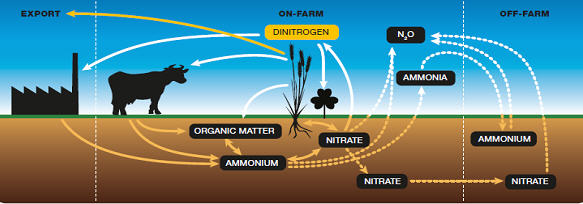
Description – Conceptual view of the nitrogen cycle on Canadian farms
Figure shows pathways of nitrogen compounds in a farm system. Movement includes transport within, import to, and consign from the system. Nitrogen is imported to the subcontract in the form of ammonium and nitrate fertilizers. Nitrogen is exported from the arrangement in the harvested crops and livestock products, ammonia and nitrous oxide losses to the air, and nitrates leached from the soil. Within the system, nitrogen from manure, fertilizer and soil organic thing is taken up by plants. Dinitrogen from the atmosphere may be fixed by legumes and be added to the soil every bit organic matter subsequently plant residues decompose.
Nitrous oxide be produced at many points in the cycle. The term dinitrogen refers to the naturally-occurring nitrogen gas (N2) that is a major component of our temper.
Nitrous oxide reduction
Since NtwoO is produced mostly from backlog bachelor nitrogen in soils, one mode to suppress emissions of this gas is to use fertilizer judiciously: adding just plenty, at the right place and time, to encounter crop demands, simply avoiding backlog amounts left over. This can reduce fertilizer costs to producers and reduce the corporeality of nitrogen lost through backlog fertilizer application.
Fertilizer tin can be used more than efficiently past:
- adjusting fertilizer rates to coincide with plant needs
- placing fertilizer near plant roots (but not also deep in the soil)
- applying fertilizer several times each year, rather than simply once
- using tedious-release forms
Similarly, using manure efficiently can also aid limit N2O emissions-not just because less is released from the manure, but also because less fertilizer now needs to be used. Possibly the most fundamental mode of reducing N2O from manures is to alter feeding rations then that less nitrogen is excreted in urine and carrion in the first place.
Other practices that can sometimes reduce NorthiiO emissions from farms include:
- greater use of legumes as a nitrogen source
- use of cover crops (sown between successive crops) to remove excess available nitrogen
- fugitive utilise of summer fallow (leaving the land unplanted, with no ingather nitrogen uptake, for a flavor)
- adjusting tillage intensity (sometimes, merely non e'er, no-till practices tin reduce emissions)
Well-nigh methods of reducing N2O emissions depend on improving the efficiency of nitrogen employ on farms. Progress toward this aim has many other benefits:
- it reduces the price of production because less fertilizer is used
- information technology saves on fossil fuel utilize (and hence CO2 emissions) because producing nitrogen fertilizer is energy intensive
- it lessens the amounts of nitrates, ammonia and other nitrogen pollutants entering the environment
Despite much progress, the nitrogen cycle on farms yet results in the leakage of N2O and reducing these leaks remains a research priority.
Measuring emissions
Greenhouse Gas (GHG) emissions from farms are measured in part to honour international commitments; for example, Canada needs to provide reliable annual estimates of emissions from all of import sources, including farms. However, emissions are also measured for scientific reasons: if y'all cannot measure emissions precisely, how can you know which of diverse practices best reduces emissions?
Without good estimates of emissions, how can y'all understand the underlying principles of GHG germination and release?
Measuring emissions of GHGs from farms is not easy; emissions come from many places on the farm: soils, animals of all kinds and machinery. Sometimes the gases seep slowly into the air; other times they spew in sporadic gusts.
To capture these emissions, scientists have devised a host of methods:
- minor chambers placed on soils or large chambers housing cows
- instrumented towers downwind of fields or instrumented shipping flying over farming regions
- methods that require patient analysis of carbon change in soils over tens of years
- measurements of carbon dioxide (COtwo) in air, several times a second
- analysis of air in tubes buried in the soil, or from tubes hung high in the air on balloons
No method is perfect, but each has its role. By pooling results from all methods, scientists obtain reasonably proficient estimates of emissions and the factors that control them. This understanding is then normally captured in models-sets of mathematical equations that can predict GHG emissions for any set of weather condition.
Such models are already widely used, but research continues to make them even more robust and reliable.
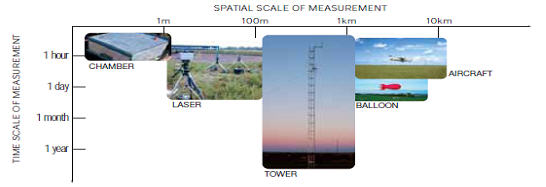
Description – The principle measurement techniques
Figure displays five measurement methods on a graph with two axes: Y axis is 'Time calibration of Measurement' and X axis is 'Spatial Calibration of Measurement'. Five gas measurement methods are located on the axes: Sleeping room, Laser, Belfry, Shipping and Balloon. Gas capture chamber technique is shown as appropriate for durations of an hr or less over areas of a metre or less. Laser applied science is shown as advisable for time periods of one hour to several days and over areas of 1 to 100m. Towers are used to measure over time periods ranging from ane 60 minutes to more than a twelvemonth and distances of 100 metres (thou) to 1,000m. Aircraft tin used to measure areas of one to ten kilometres and for parts of a single day. Balloons tin can be used for areas like to shipping simply periods of time up to several days.
A variety of measurement techniques are used to estimate GHG emissions from Canadian agriculture. Each measurement technique is appropriate over a specific time and expanse, represented by the size of the photograph in the figure. Past combining measurement techniques that embrace different fourth dimension frames and areas, scientists can gauge GHG emissions from areas smaller than i square metre to several square kilometres and from time frames of a few minutes to several years.
Source and Photo Credits: R. Desjardins, E. Pattey, Agronomics and Agri-Food Canada, Ottawa, Ontario and P.-50. Lizotte. McGill University, Montreal, Quebec
The amount of emissions we produce
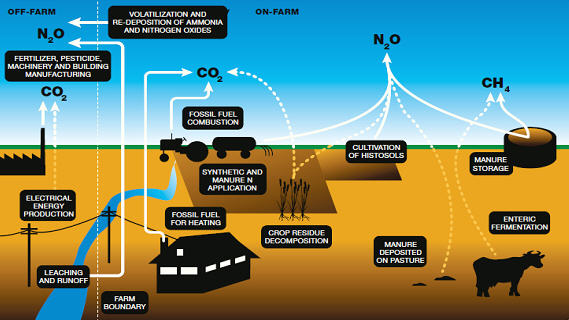
Description – On- and off-farm sources of greenhouse gas emissions
Figure shows sources of greenhouse gas emissions attributed to agriculture both on- and off-farm. On-subcontract emissions include methane emissions from manure, nitrous oxide emissions from manure, soil cultivation, ingather rest decomposition and fossil fuel combustion, and carbon dioxide emissions from crop remainder decomposition, and fossil fuel combustion. Off-subcontract emissions carbon dioxide emissions in the production of electricity, fertilizers, pesticides, machinery and building supplies, and nitrate and nitrous oxide losses from leachates.
In 2009, Canada produced 690 meg tonnes of CO2 equivalents (Mt CO2e) from all sources, mostly as CO2 from energy employ. Agriculture accounted for about 8% of these emissions (56 Mt COtwoe), largely as CH4 (about two-thirds) and N2O (almost one-third). This value does non include emissions from energy use; if these are counted, then agriculture accounts for roughly 10% of Canada's emissions.
Equally mentioned, farm soils remove substantial COii from the air when soils gain carbon under improved practices (about 12 Mt CO2east were removed in 2009). In fact, Canadian croplands have been a net sink for CO2 starting in well-nigh 1990. However, until recently the removals on croplands were kickoff by carbon losses from forests and grasslands recently converted to cropland. It is merely since about 2000 that agricultural lands have been a cyberspace sink for CO2 when land use change is taken into account.
The annual full GHG emissions from farms in Canada take increased from 1990 to 2009 (See Figure below). The master driver is the increase in the beefiness and swine populations, although they take stabilized in recent years.
Since 2005, emissions from the agriculture sector take stabilized. Declines in emissions from livestock production are being offset by increases in emissions from crop product.
In 2009, a continued reduction in emissions from livestock production and a reduction in emissions from crop production resulted in an apparent decrease in emissions. However, this reduction may exist insignificant in relation to inter-annual variability or climate variability from twelvemonth to year.
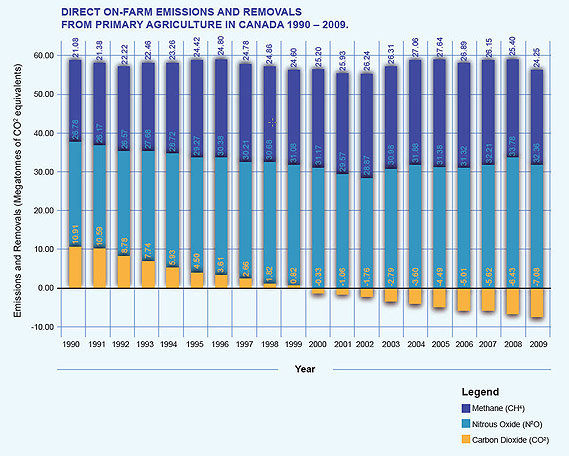
Description – Carbon dioxide, methyl hydride and nitrous oxide emissions and removals from 1990 to 2009 for Canadian agriculture
The chart shows emissions and removals (sources and sinks) in COii equivalents on the y axis and years on the ten axis. Values below 0 are sinks (removals) and values above 0 are emissions. If the C sinks are taken into account as emissions offsets, cyberspace emissions in agriculture have declined relative to 1990.
| CO2 metric tonnes | Northtwo0 metric tonnes | CH4 metric tonnes | total metric tonnes | |
|---|---|---|---|---|
| 1990 | 10.91 | 26.78 | 21.08 | 58.77 |
| 1991 | ten.59 | 26.17 | 21.38 | 58.14 |
| 1992 | 8.78 | 26.57 | 22.22 | 57.57 |
| 1993 | 7.74 | 27.68 | 22.46 | 57.87 |
| 1994 | 5.93 | 28.72 | 23.26 | 57.91 |
| 1995 | 4.l | 29.27 | 24.42 | 58.19 |
| 1996 | iii.61 | 30.38 | 24.eighty | 58.79 |
| 1997 | 2.66 | 30.21 | 24.78 | 57.65 |
| 1998 | 1.82 | 30.68 | 24.86 | 57.36 |
| 1999 | 0.82 | 31.08 | 24.threescore | 56.51 |
| 2000 | −0.33 | 31.17 | 25.20 | 56.05 |
| 2001 | −1.06 | 29.57 | 25.93 | 54.45 |
| 2002 | −one.76 | 28.87 | 26.24 | 53.36 |
| 2003 | −2.79 | 30.98 | 26.31 | 54.50 |
| 2004 | −3.60 | 31.88 | 27.06 | 55.33 |
| 2005 | −4.49 | 31.38 | 27.64 | 54.53 |
| 2006 | −5.01 | 31.32 | 26.89 | 53.20 |
| 2007 | −5.62 | 32.21 | 26.xv | 52.74 |
| 2008 | −6.43 | 33.78 | 25.40 | 52.74 |
| 2009 | −7.08 | 32.36 | 24.25 | 49.54 |
These estimates may not be perfectly authentic; all deport some uncertainty, in particular those for nitrous oxide (North2O). Simply they provide a reliable view of general trends and their uncertainty may slowly shrink with further research and gradually improving methods.
What will happen to GHG emissions in coming years? With growing need for food and other products, livestock numbers and nitrogen additions may ascent further, perhaps increasing CHfour and NorthtwoO emissions, unless new ways can be found to suppress them. Soil carbon gains (CO2 removals from the air), which accept offset by increases in methane (CHiv) and Northward2O emissions, may continue for some years, but not indefinitely; eventually, soil carbon approaches a maximum, typically a few decades after introducing new practices.
Even with proficient practices, therefore, it is difficult to foresee farm GHG emissions falling appreciably over time. More of import than reducing total emissions, nevertheless, may exist finding ways to reduce emissions per unit of product. In the last 15 years, for example, dairy farmers have reduced CH4 emissions per kilogram of milk by nearly 13%, and like trends are occurring with beef and pork.
International efforts
Climate modify is one of the biggest problems facing countries around the world - the claiming for the agronomics and agri-food sector is to mitigate greenhouse gases (GHG) and adapt to the impacts of climatic change without jeopardizing nutrient security. Between 1990 and 2005, agriculture emissions in developing countries increased by 32% and agriculture and land use change (deforestation) currently correspond about a third of global emissions. It is anticipated that agricultural emissions will go on to ascent in response to demand for nutrient and free energy, especially in some developing countries.
The world volition be challenged to come across the global demand for food, along with the demand to use increasing amounts of biomass for free energy and other purposes (similar building materials, chemicals etc.). Nearly 1 billion people are currently malnourished and the number will grow every bit the world population is expected to approach 9 billion past 2050.
Climatic change could chemical compound the challenge past reducing the productive potential of some electric current food producing areas - in that location is growing business organization about long-term food security, specially in least developed countries and parts of Africa.
The Food and Agronomics Organization provides an overview of the issues facing the agriculture and agri-food sector in a recent publication Coping with a changing climate: considerations for adaptation and mitigation in agriculture.
Concern about man interference with the global climate system led 192 countries to join an international treaty - the United nations Framework Convention on Climate Change (UNFCCC) - more than than a decade ago.
The Climate Convention has the goal of preventing "dangerous" man interference with the climate system by limiting emissions of greenhouse gases from human activities. It is i of three international agreements adopted at the 1992 "Rio Earth Tiptop." The others – the Convention on Biological Diverseness and the Convention to Combat Desertification – involve matters strongly afflicted by agronomics and climate alter.
One of the major accomplishments of the Convention is that information technology requires developed countries to provide annual inventories of greenhouse gas emissions from human activities related to the energy, transportation, industry, waste and agriculture and forest sectors (developing countries also are encouraged to acquit out inventories).
Countries recognized that understanding the size of the trouble is an important first pace in finding solutions.
The annual inventories showed that global greenhouse gas emissions connected to rise through the early 1990s. In 1997, countries agreed to the Kyoto Protocol, an international agreement that sets legally binding greenhouse gas emission reduction targets for 37 developed countries and the European Marriage for reducing (GHG) emissions.
In full, the reductions corporeality to an average of v% confronting 1990 levels over the five-year period 2008 to 2012.
Countries are currently negotiating a new international agreement in which all major GHG emitting countries will have emission reduction commitments. About countries, including Canada, recognize that the agriculture and agri-food sector could contribute to the success of a future understanding. The sector could as well benefit from a focus on approaches that heighten mitigation and adaptation actions, in detail by improving the efficiency and productivity of agriculture systems.
Given the expected increase in nutrient need over the next decades, managing emissions associated with food production volition exist important. Canadian farmers are relatively GHG-efficient and could exist a leader in developing climate-smart agricultural systems.
More information on Greenhouse gases is bachelor from the publication Better farming, better air: a scientific assay of farming practice and greenhouse gases in Canada.
More information virtually Canada'southward action on climate change is available from Environment Canada.
Source: https://agriculture.canada.ca/en/agriculture-and-environment/climate-change-and-air-quality/greenhouse-gases-and-agriculture

Post a Comment for "Why Does Eating Beef Contribute to the Greenhouse Effect Yahoo Answer"